
Everest offers intensive care clues
Friday October 7th, 2011
Nitric oxide may improve the recovery of critically ill patients in intensive care, according to research conducted on the slopes of the world's highest mountain.
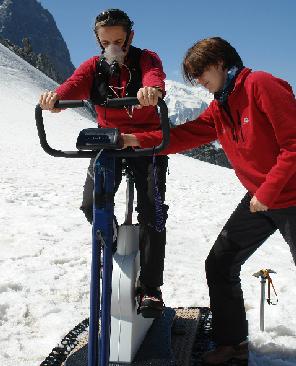 Results
from an expedition to Mount Everest, which looked at the body’s
response to low oxygen levels, found that production and activity of nitric
oxide (NO) are higher in people who live at near sea-level altitudes and
ascend to altitude, which leads to changes in blood flow in the smallest
blood vessels.
Results
from an expedition to Mount Everest, which looked at the body’s
response to low oxygen levels, found that production and activity of nitric
oxide (NO) are higher in people who live at near sea-level altitudes and
ascend to altitude, which leads to changes in blood flow in the smallest
blood vessels.
The findings, published in the journal Scientific Reports this week, claim that interventions to alter NO production – some of which already exist as drugs or gas – may benefit critically ill patients in whom oxygen availability is limited.
The collaborative study between scientists at University College London, UK, and the University of Warwick, UK, made use of blood samples and results collected at varying altitudes during the 2007 Caudwell Xtreme Everest (CXE) expedition.
A total of 198 trekkers and 24 climbers, including doctors and scientists, took part in the CXE, which made the first ever measurement of the oxygen level in human blood at 8,400m on Mount Everest.
The study was led by UCL, while blood and statistical analyses were carried out by the University of Warwick.
Dr Denny Levett, joint lead author of the paper from the UCL Centre for Altitude, Space and Extreme Environment Medicine and deputy research lead of the CXE expedition, said: “Climbing to extreme altitudes puts the body in an environment with very low oxygen availability, similar to the experience of patients in intensive care with diseases affecting the heart, lungs or vascular system.
“By taking blood samples from hypoxic, but otherwise healthy, individuals we have been able to show that the body’s natural response to low oxygen availability is to increase the production of nitric oxide. Thus, elevated NO occurs not just in those who live at high altitudes permanently, but also in lowlanders who are trying to adapt to high altitude conditions.”
Dr Martin Feelisch, joint senior author of the paper and a professor of experimental medicine and integrative biology at Warwick Medical School, said: “This research may herald a change in emergency treatment and intensive care.
“It suggests there is an alternative way of alleviating the consequences of low oxygen levels by creating a more sustained tolerance to those low levels through treatments which boost NO production.”
The role of nitrogen oxides in human adaptation to hypoxia. Scientific Reports October 2011
Tags: A&E | General Health | UK News
 Printer friendly page