
Do Santa's sleepless nights risk his health?
Friday December 17th, 2010
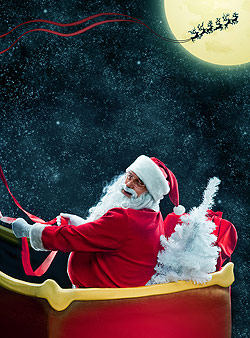
Santa Claus and his elves could be risking their health by staying awake for days and nights at a time to deliver presents to children all over the world, experts have claimed.
 Sleep
experts Professor Franco Cappuccio and Dr Michelle Miller, from the Warwick
Medical School, said Santa – and others – need at least six
hours’ sleep a night to mitigate long-term health risks.
Sleep
experts Professor Franco Cappuccio and Dr Michelle Miller, from the Warwick
Medical School, said Santa – and others – need at least six
hours’ sleep a night to mitigate long-term health risks.
“Considering that he does it only once a year, it may not be too bad for his long-term health” said Prof Cappuccio. “However, in the short term there are risks. Lack of sleep will make him drowsy, his vigilance will fade and his ability to think and remember will diminish.
“There is risk for himself and others: he could fall asleep at the reins and crash his sleigh, he could even end up delivering the wrong present to the wrong person.”
Prof Cappuccio recommended that Father Christmas take a few short naps of no more than 20-minute naps if he is unable to enjoy a good night’s sleep and enjoy one large cup of coffee.
“It will usually have an effect after about 20 minutes, so have a nap before setting off again,” he said.
But he warned if Santa drank repeated cups of coffee, the effect would reduce with time and he may also suffer unpleasant side effects, like palpitations and high blood pressure.
Householders have been recommended to leave Santa a snack – but not alcohol - when he visits.
“Sleep deprivation increases appetite, so he appreciates a bit of grub to keep him going,” explained Prof Cappuccio.
“Since sleep debt also leads to obesity, his pot belly is not a surprise to us. Don’t leave him any booze, though! His sleepiness and tiredness already brings his attention to the level of someone who is over the alcohol limit, and there would be a real risk of him crashing his sleigh.”
Because Santa has to travel so quickly through so many time zones, there is little time for his body clock to adapt.
“Catch-up sleep helps to recover from the short-term tiredness and fatigue, but will not help avoid the long-term consequences of sleep deprivation,” said Prof Cappuccio.
“If he were to do this all year round, he would definitely run the risk of dying prematurely. However, children, be reassured: he only does it once a year for us all, and by following my instructions he will remain fresh and zippy!”
Sleep, Health and Society, Cappuccio FP, Miller MA & Lockley SW eds. Oxford University Press, 2010; pp. 1-471 (ISBN 978-0-19-956649-4)
Tags: General Health | UK News | World Health
 Printer friendly page