
Making a cancer gene overactive could pave the way for the first curative treatment for heart disease, British scientists have announced.
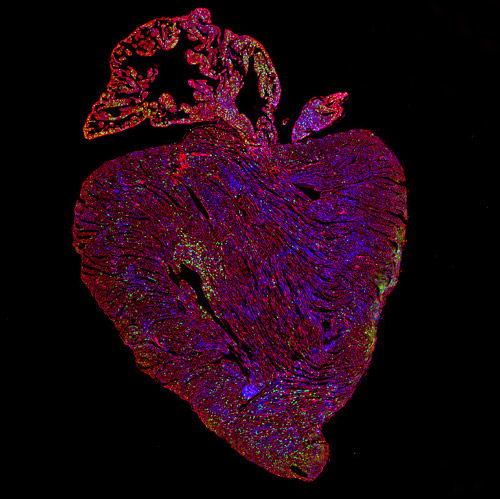 Triggering heart cell regeneration in mouse models have been described by researchers at the University of Cambridge, UK, as “really exciting” because adult hearts cannot usually repair themselves once damaged.
Writing in Nature Communications, they say harnessing the power of this gene represents major progress towards a treatment.
They investigated the Myc gene, which plays a key role in the cycle through which cells make copies of themselves. The Myc gene is overactive in most cancers, and controlling it is the focus of much cancer research.
However, now Dr Catherine Wilson of the University of Cambridge, UK, and colleagues have discovered that Myc behaves differently in the heart to other areas.
In tests on mice, they made Myc overactive and this triggered enormous cell replication in the liver and lungs, among other organs. But heart cells did not proliferate.
On further investigation, the team found that Myc needs another protein called Cyclin T1, made by a gene called Ccnt1, to create heart cells. Only when both genes are expressed together does the heart switch to a regenerative state and replicate its cells.
The findings were published yesterday (14 April) in Nature Communications.
Dr Wilson says: “This is really exciting because scientists have been trying to make heart cells proliferate for a long time. None of the current heart disease treatments are able to reverse degeneration of the heart tissue – they only slow progression of the disease. Now we’ve found a way to do it in a mouse model.
“We found that even when Myc is switched on in a heart, the other tools aren’t there to make it work, which may be one of the reasons heart cancer is so extremely rare. Now we know what’s missing, we can add it and make the cells replicate.”
The team now hopes to develop a genetic therapy for the treatment of heart disease.
Bywater, M. J. et al. Reactivation of Myc transcription in the mouse heart unlocks its proliferative capacity. Nature Communications 14 April 2020; doi: 10.1038/s41467-020-15552-x
Leave a Reply