
The recently discovered quadruple helix may hold the key to new kinds of treatment for cancer, researchers said last night.
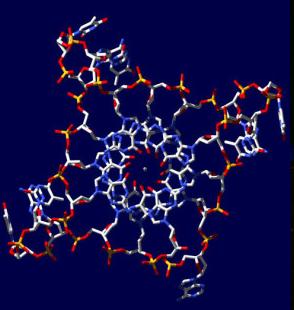 The quadruple helix was discovered at Cambridge University three years ago.
Now the Cambridge researchers say they seem to be found in regions of DNA responsible for the control of genes.
The scientists examined a pre-cancerous human cell line, detecting about 10,000 quadruple helixes, also known as G-quadruplexes. They found them especially concentrated in genes linked with cancer, they report in Nature Genetics.
Researcher Professor Shankar Balasubramanian, from Cambridge University, said: "What we observed is that the presence of G-quadruplexes goes hand in hand with the output of the associated gene.
"We’ve been looking for an explanation for why it is that certain cancer cells are more sensitive to small molecules that target G-quadruplexes than non-cancer cells.
"One simple reason could be that there are more of these G-quadruplex structures in pre-cancerous or cancer cells, so there are more targets for small molecules, and so the cancer cells tend to be more sensitive to this sort of intervention than non-cancer cells.
"It all points in a certain direction, and suggests that there’s a rationale for the selective targeting of cancer cells."
Dr Emma Smith, from Cancer Research UK, which is backing the research, said it was "still early days."
She said: "Figuring out the fundamental processes that cancer cells use to switch genes on and off could help scientists develop new treatments that work against many types of the disease. And exploiting weaknesses in cancer cells could mean this approach would cause less damage to healthy cells, reducing potential side effects."
G-quadruplex structures mark human regulatory chromatin Nature Genetics 12 September 2016
Leave a Reply