
World War I private Ernest Cable died not from a bullet but from dysentery – but his death is now helping to save millions of lives, experts say today.
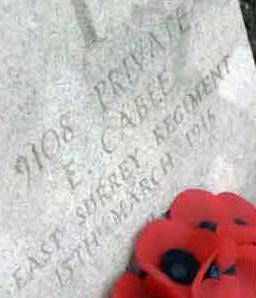 Private Cable’s story is among several reports today of the legacy of medicine in the brutal conflict which began 100 years ago.
His contribution was that scientists conducted a detailed study of his death in 1915 and isolated the bacteria which killed him – Shigella flexneri.
The samples were the first to be placed in the national collection, housed partly at Porton Down, Wiltshire.
The infection which killed Private Cable has since been compared with other strains of the organism.
Reporting in The Lancet, researchers say this has helped them track genes responsible for antibiotic resistance – and that some of these existed in 1915 before humans used antibiotics.
Private Cable’s own story has only just been uncovered by researchers who set out to find the source of the sample. Researcher Dr Alison Mather was even able to track down his memorial plaque, held by members of the family that gave him lodgings before he left for the war.
Julie Russell, of Public Health England, said: “It is tragic that Private Cable died of dysentery alongside many other soldiers during WW1 due to the terrible conditions in the trenches. Unfortunately, even 100 years later this bacteria is the cause of death of hundreds of thousands of people in developing nations each year.
"The root cause both now and back in the trenches in WW1 is poor sanitation."
Researcher Dr Kate Baker, from the Wellcome Trust Sanger Institute, said: “Even before the description and widespread use of penicillin, this bacterium was resistant to it.
“While only 2% of the genome from this first sample differs from modern isolates, the changes that Shigella flexneri has acquired enable it to evade the antimicrobial treatments we use to fight it.”
* In a second report in the journal, surgeons discuss the improvements and problems that remain in the care of soldiers who lose their limbs.
A century ago doctors could do nothing to relieve the pain felt by these patients – and doctors still struggle to relieve the chronic suffering of these people, they report.
In contast doctors can now offer sophisticated prosthetic technology.
Historian Dr Emily Mayhew worked with pain specialist Professor Andrew Rice and army surgeon Major Dafydd Edwards at Imperial College London. They report how surgeons attempted to change techniques to reduce the pain.
Dr Mayhew said: “Our findings were pretty depressing. Not much could be done.
"Although surgeons worked very hard to understand and resolve the chronic pain problems that many amputee patients faced during and after the Great War, they really weren’t able to get to grips with them.”
Professor Rice said: “In the last century, there have been significant advances in our understanding of how the brain and nervous system respond to amputation and nerve injury, in the rehabilitation process and prosthesis technology; but in terms of our therapies for the chronic pain that can follow an amputation, really we’ve not advanced much since the First World War.”
Mather, A, et al. Bacillary dysentery from World War 1 and NCTC1, the first bacterial isolate in the National Collection. Lancet 7 November 2014; doi: 10.1016/S0140-6736(14)61790-6
Baker, K, et al. The extant World War 1 dysentery bacillus NCTC1: a genomic analysis. Lancet 7 November 2014. DOI: 10.1016/S0140-6736(14)61789-X
D.S. Edwards et al. "Doomed to go in company with miserable pain" Surgical recognition and treatment of amputation-related pain for casualties on the Western Front of the Great War. Lancet 7 November 2014 [abstract]
Leave a Reply