
A London professor is to share this year’s Nobel Prize for medicine with two Norwegians, it has been announced.
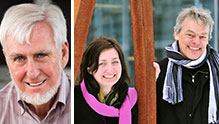 The three scientists gained the award for unravelling the mysteries of the brain’s ability to map around it – the so-called inner GPS.
Professor John O’Keefe, of University College, London, first identified nerve cells involved in this system in 1971.
Further key discoveries were made in 2005 by his fellow laureates, Professors May-Britt Moser and Edvard Moser of the Norwegian University of Science and Technology.
A spokesman for the Nobel Assembly in Sweden said: "The discoveries of John O’Keefe, May-Britt Moser and Edvard Moser have solved a problem that has occupied philosophers and scientists for centuries – how does the brain create a map of the space surrounding us and how can we navigate our way through a complex environment?
"The discovery of the brain’s positioning system represents a paradigm shift in our understanding of how ensembles of specialised cells work together to execute higher cognitive functions. It has opened new avenues for understanding other cognitive processes, such as memory, thinking and planning."
The president of University College London, Professor Michael Arthur said: "John O’Keefe is one of UCL’s outstanding neuroscientists and I am delighted that his work on the very basic question of how the hippocampus in the brain stores spatial information and thus allows us to navigate our way through a complex world, has been recognised by the award of the Nobel Prize in Medicine.
"John continues his ground-breaking work as the first Director of the Sainsbury Wellcome Centre for Neural Circuits and Behaviour and I am delighted that this new institute at UCL will be guided and led by such a distinguished scientist."
Leave a Reply