
Scientists have developed a new method of targeting drugs using molecular "robots" which pinpoint the specific cells involved in a disease.
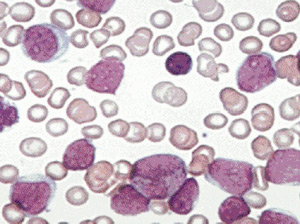 Dr Sergei Rudchenko of the Hospital for Special Surgery, New York, USA, and his team set out to design molecular robots, or automatons, that identify certain receptors on a cell’s surface.
The automatons are made up of antibodies and short DNA strands called oligonucleotides, which can be made in the lab. To create them, the team focused on white blood cells, which have a range of receptors – some general (e.g. CD45) and some specific to sub-groups (e.g. CD3).
They made several automatons, each with an antibody that fits to a certain receptor, and a DNA component that joins together with DNA from another automaton.
When mixed with human blood, the automatons found the right type of cell by searching for the corresponding receptors. For example, when they found a cell that has both CD45 and CD3 receptors, the automatons looking for each receptor both attached themselves to the cell.
Once both were present, the DNA from the two automatons joined together, making a unique label for this particular type of cell. The process takes about 15 minutes, after which drugs can be sent to these cells only. The scientists believe that, by using a greater number of automatons, increasingly specific subsets of cells can be targeted.
Dr Rudchenko says: "This is a proof of concept study using human cells. The next step is to conduct tests in a mouse model of leukaemia." Full details appear in the journal Nature Nanotechnology.
Rudchenko, M. et al. Autonomous molecular cascades for evaluation of cell surfaces. Nature Nanotechnology 28 July 2013 doi:10.1038/nnano.2013.142
Leave a Reply