
Quadruple helix clue to cancer
Monday January 21st, 2013
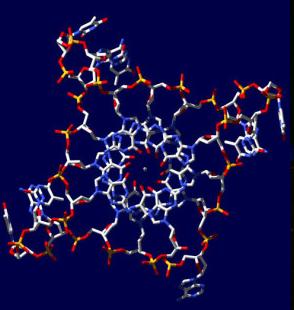
Human genes contain DNA arranged in quadruple helixes - and it is sometimes linked to cancer, British researchers revealed last night.
 The
finding is the latest to suggest the human genetic map is more complex
than was thought until recently.
The
finding is the latest to suggest the human genetic map is more complex
than was thought until recently.
It is 60 years since Cambridge University, UK, scientists discovered the "double helix" organisation of DNA.
And the latest findings have come from the same university.
The researchers say the quadruple helix seems to be connected to DNA replication.
They believe it is more common in cancer cells and their research was backed by Cancer Research UK.
The findings were published last night in Nature Chemistry. Until now scientists believed the quadruple helix was just a theoretical possibility.
The researchers say the discovery of the quadruple helix may lead to new kinds of cancer treatment.
Researcher Professor Shankar Balasubramanian said the finding was a "real landmark".
He said: "We are seeing links between trapping the quadruplexes with molecules and the ability to stop cells dividing, which is hugely exciting.
"The research indicates that quadruplexes are more likely to occur in genes of cells that are rapidly dividing, such as cancer cells.
"For us, it strongly supports a new paradigm to be investigated - using these four-stranded structures as targets for personalised treatments in the future."
He added: "There is a lot we don't know yet. One thought is that these quadruplex structures might be a bit of a nuisance during DNA replication - like knots or tangles that form.
"Did they evolve for a function? It's a philosophical question as to whether they are there by design or not - but they exist and nature has to deal with them. Maybe by targeting them we are contributing to the disruption they cause."
Professor Balasubramanian said: "The possibility that particular cancer cells harbouring genes with these motifs can now be targeted, and appear to be more vulnerable to interference than normal cells, is a thrilling prospect.
"The 'quadruple helix' DNA structure may well be the key to new ways of selectively inhibiting the proliferation of cancer cells."
Nature Chemistry January 20 2013
 Printer friendly page