
Black Death bacterium confirmed by DNA technique
Friday September 2nd, 2011
Analysis of the skeletons of medieval plague victims has confirmed conclusively for the first time that the bacterium yersinia pestis was responsible for the Black Death in mediaeval times.
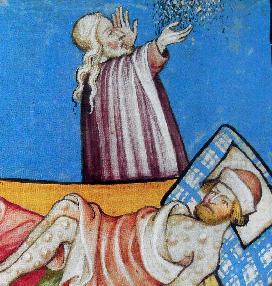 It was
not certain that the bacterium, which is known to cause the plague today,
was responsible for the world’s most deadly outbreak of disease
in the 14th century.
It was
not certain that the bacterium, which is known to cause the plague today,
was responsible for the world’s most deadly outbreak of disease
in the 14th century.
But researchers at the University of Tübingen’s Institute of Scientific Archaeology, Germany, and McMaster University in Canada have confirmed that yersinia pestis was behind the disease that wiped out one-third of Europeans.
They came to the conclusion after decoding for the first time a circular genome – the pPCP1 plasmid – that comprises about 10,000 positions in the bacterium’s DNA.
Their findings have been published in the Proceedings of the National Academy of Sciences of the United States of America.
The working group in Tübingen, led by Dr Johannes Krause, took DNA samples from skeletons in a London plague cemetery and used a new technique called “molecular fishing”, which enriched plague DNA fragments from tooth enamel and sequenced them.
The fragments were connected up into a long genome sequence, which turned out to be identical to modern-day plague pathogens. “That indicates that at least this part of the genetic information has barely changed in the past 600 years,” says Dr Krause.
“Without a doubt, the plague pathogen known today as y. pestis was also the cause of the plague in the Middle Ages.”
Previous genetic tests indicating that the bacterium was present in medieval samples had previously been dismissed as contaminated by modern DNA or the DNA of bacteria in the soil.
Tags: Europe | General Health | Genetics | North America | UK News
 Printer friendly page