
An astronaut on the International Space Station has spoken of how it is contributing to the development of “extreme medicine.”
 The new specialty is to be discussed at the World Extreme Medicine Conference and Expo in November.
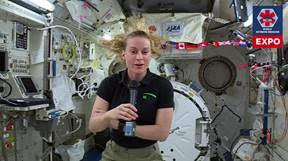
In the recording, made ahead of the conference that takes place in Edinburgh, Kate Rubins, who is one of three astronauts aboard ISS, stresses importance of extreme medicine.
“Here in Earth orbit we have a unique appreciation of the concepts of ‘extreme’ and ‘remote’, very applicable to the World Extreme Medicine Conference, especially provisioning and point-of-care diagnostics in similar remote environments as well as on a wider global scale,” she says.
“The concept of extreme medicine resonates with so many corners of human health, such as disaster and humanitarian medicine, pre-hospital care, wilderness medicine, and in isolated villages in the developing world.
“The breaking down of traditional silos between these disciplines is leading to more effective treatments and devices, and of course the sharing of knowledge and best practices on a wider stage.”
Attendees at the World Extreme Medicine Conference specialise in medical practice in remote and sometimes dangerous locations.
It will cover four core disciplines and will comprise 100 key speakers.
Highlights will include a session by Dr David Nott, an NHS surgeon who works regularly overseas for Médecins Sans Frontières and the International Federation of the Red Cross. He will talk about his most recent work at a makeshift hospital in Aleppo, Syria.
Dr John Cherry, a rural doctor in Orange, New South Wales, about 150 miles west of Sydney, Australia, will reveal how he created the blueprint for preparing ESA astronauts for medical situations in space, while American MD Will Smith is travelling from Jackson, Wyoming, where he is the US National Parks medical director.
Other speakers will include the elite sports expert, Edinburgh-based Dr Andrew Murray, who has worked for the Olympic, Paralympic and Commonwealth games, and Eoin Walker, a pre-hospital mass casualty incident management paramedic with the London Air Ambulance.
World Extreme Medicine Founder Mark Hannaford said: “In today’s world, more than ever before, the human race is determined to access remote areas, whether it be for science, exploration, business or a myriad of other reasons. People going into these areas need medical support, and the skillsets of the medical professionals required are very different to those needed in a traditional clinical environment.
“Likewise, there are conflicts and disasters happening in parts of the world where access to equipment and medicine is extremely difficult or impossible. Medical professionals in these conditions need to be able to work with very limited resources and frequently overcome new challenges.
“The area of extreme medicine is in growth, and our message is that it’s a great alternative to a traditional clinical career. My belief is that there’s never been a more exciting time to work in medicine, and the fascinating speakers at the World Extreme Medicine Conference will prove that point.”
The World Extreme Medicine Conference and Expo will be held at Dynamic Earth in Edinburgh on Friday 18 to Monday 21 November. Kate Rubins’ message can be viewed at: vimeo.com/184097597
Leave a Reply