
A Chinese scientist who turned to a 1,600 year old text book to combat malaria was honoured with the medical Nobel Prize yesterday.
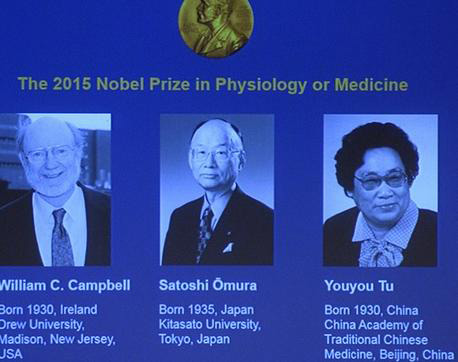 YouYou Tu, of the China Academy of Traditional Chinese Medicine, was responsible for the discovery of artemisinin, a drug that has transformed the treatment of malaria and is credited with saving millions of lives.
She shared the Nobel Prize with two other scientists who jointly developed therapy for roundworm parasites, William Campbell, of Drew University, New Jersey, USA, and Satoshi Omura, of Kitasato University, Japan.
As a traditional medicine expert, the Chinese scientist discovered that the sweet wormwood – Artemisia annual – was a promising treatment for malaria after investigating 2,000 herbal remedies, all the while against the backdrop of Mao’s Cultural Revolution.
But she struggled to find an effective formation of the plant until she turned to a handbook from AD350 – Ge Hong’s A Handbook of Prescriptions for Emergencies, which explained how to make an effective potion.
She published an account of the discovery in Nature Medicine in 2011, stating: "During the Cultural Revolution, there were no practical ways to perform clinical trials of new drugs. So, in order to help patients with malaria, my colleagues and I bravely volunteered to be the first people to take the extract.
"After ascertaining that the extract was safe for human consumption, we went to the Hainan province to test its clinical efficacy, carrying out antimalarial trials with patients."
A citation from the Nobel Assembly at the Karolinska Institute, Sweden, said: “These two discoveries have provided humankind with powerful new means to combat these debilitating diseases that affect hundreds of millions of people annually.
"The consequences in terms of improved human health and reduced suffering are immeasurable."
Leave a Reply