
A "pill on a string" is helping researchers make significant findings about cancer of the gullett, it was announced last night.
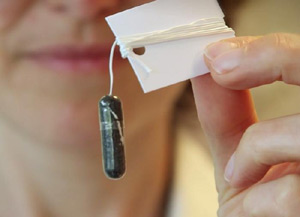 The pill allows doctors to extract cells from along the length of the oesophagus – the gullett or foodpipe – without using biopsies.
After patients swallow it, the outer part of the pill dissolves, releasing a sponge. This can then be drawn back up the throat, allowing the collecting of cell samples.
The Cambridge University researchers reported their latest findings in Nature Genetics.
They say they have been able to show how Barrett’s oesophagus develops into cancer.
Their study found genetic changes early in the process. On average there were 12,000 mutations in the tissue of people without cancer – compared with 18,000 mutations by the time cancer developed.
Researcher Professor Rebecca Fitzgerald said: "The trouble with Barrett’s oesophagus is that it looks bland and might span over 10cm.
""We created a map of mutations in a patient with the condition and found that within this stretch, there is a great deal of variation amongst cells. Some might carry an important mutation, but many will not.
"If you’re taking a biopsy, this relies on your hitting the right spot. Using the Cytosponge appears to remove some of this game of chance."
Fellow researcher Dr Caryn Ross-Innes said: "We know very little about how you go from pre-cancer to cancer – and this is particularly the case in oesophageal cancer.
"Barrett’s oesophagus and the cancer share many mutations, but we are now a step closer to understanding which are the important mutations that tip the condition over into a potentially deadly form of cancer."
Ross-Innes, CS et al. Whole-genome sequencing provides new insights into the clonal architecture of Barrett’s esophagus and esophageal adenocarcinoma. Nature Genetics 20 July 2015.
Leave a Reply