
An Ebola vaccine has shown promise in tests on volunteers, US researchers announced last night.
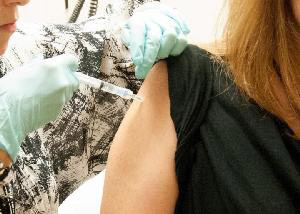 Some 20 volunteers have been testing the vaccine partly developed by the US National Institutes of Health.
Researchers said all the volunteers developed antibodies against Ebola within four weeks of having the injection.
They reported their findings in the New England Journal of Medicine.
The vaccine contains genetic material from two species of the virus, the Sudan and the Zaire and uses a virus that causes colds in chimpanzees as the carrier. The adenovirus is harmless to humans, developers say.
The researchers say that in some volunteers the vaccine also stimulated the production of T-cells that might help in the response to the Ebola virus.
They report that no volunteers suffered serious side-effects – although two endured a short fever.
Dr Anthony Fauci, director of the US National Institute of Allergy and Infectious Diseases, said: "Based on these positive results from the first human trial of this candidate vaccine, we are continuing our accelerated plan for larger trials to determine if the vaccine is efficacious in preventing Ebola infection.
"The unprecedented scale of the current Ebola outbreak in West Africa has intensified efforts to develop safe and effective vaccines, which may play a role in bringing this epidemic to an end and undoubtedly will be critically important in preventing future large outbreaks."
JE Ledgerwood et al. Safety and immunogenicity of chimpanzee adenovirus vector Ebola vaccine: preliminary report. NEJM 26 November 2014; doi: 10.1056/NEJMoa1410863 (2014).
Leave a Reply